

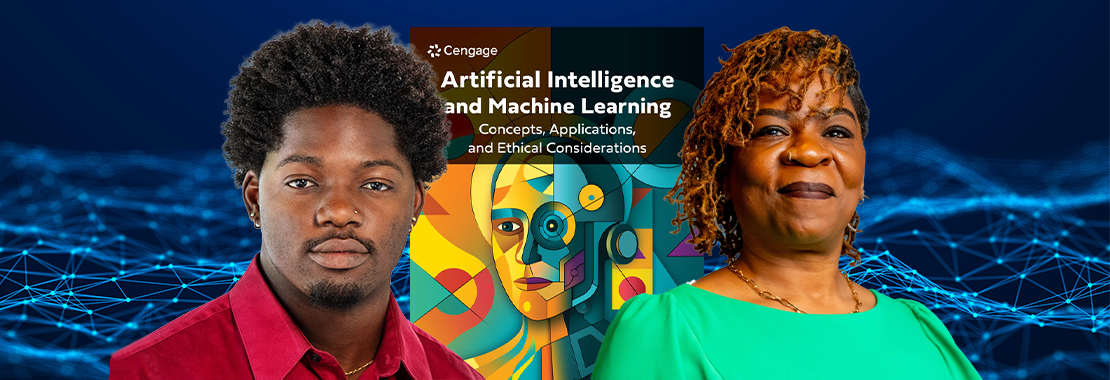
As AI becomes more ingrained in learning and the workforce, the conversation is no longer just about technology. “It’s increasingly about how to use AI responsibly, effectively, and ethically in everyday work,” says Sha’Kia Riggins, Dean of Information Technology at Florida State College at Jacksonville.
More than 50% of higher ed instructors agree that teaching students responsible and effective AI use should be a top priority. For computing and IT students, AI literacy now means going beyond using AI to evaluating AI-generated content, identifying bias, verifying information, and making informed decisions.
Sha’Kia Riggins and Baffour Osei, Robotics Lab Manager at Princeton University, address these evolving needs in their new first edition, “AI and Machine Learning: Concepts, Applications, and Ethical Considerations.” This approachable text combines conceptual understanding, ethical AI, Python programming, and authentic coding experiences to help students understand how AI and machine learning work, develop practical skills, and think critically about the technology they build and use.
Creating an accessible path into AI and machine learning
AI and machine learning can be intimidating, particularly for students encountering the subjects for the first time. Both Sha’Kia and Baffour wanted “AI and Machine Learning” to be accessible, expanding who has the opportunity to understand, contribute to, and shape emerging technology.
“My passion for teaching grew from wanting to explain complex concepts,” Sha’Kia says. “Topics like algorithms, big data, and neural networks can be broken down so anyone can learn and apply them.”
Rather than beginning with advanced mathematics or highly technical theory, the text provides a scaffolded path that allows students to gradually build their knowledge and confidence. Students encounter straightforward explanations, real-world examples, and hands-on activities that progress from no-code and low-code experiences to Python programming. Students can first explore how a concept works without being overwhelmed by syntax. As their understanding develops, they can begin experimenting, customizing, and creating.
“I’ve worked hard towards building learning environments that can meet participants where they are and scaffold their entry into unfamiliar spaces with a discovery-based methodology,” says Baffour.
How “AI and Machine Learning” offers a new approach
AI and machine learning courses can easily become heavily focused on algorithms, mathematical theory, or technical exercises. This course takes a broader approach, treating AI as a practical, ethical, and career-relevant field.
Key differentiators of “AI and Machine Learning”
- Ethics are built into every lesson, helping students consider the real-world impact of AI throughout the course
- Critical thinking is a central focus, teaching students to evaluate AI outputs, identify errors and bias, and use AI responsibly
- Multiple entry points allow students to gradually progress to coding and AI development
- Simple, memorable examples make complex AI concepts easier to understand
- Students get workforce-ready practice as they use modern AI, machine learning operations (MLOps), and emerging technologies
By connecting technical skills, ethical decision-making, and hands-on practice, the text prepares students to use AI while understanding, evaluating, and building with it.
Take students from learning to doing with “AI and Machine Learning” and MindTap
“AI and Machine Learning” includes a fully integrated experience in MindTap, Cengage’s learning platform, to help students move from understanding concepts to applying them.
“The MindTap course experience brings the textbook to life by transforming concepts into interactive, hands-on learning experiences,” says Sha’Kia. “While the textbook provides the foundational knowledge, ethical frameworks, and real-world context, MindTap allows students to immediately apply what they learn through guided activities, simulations, knowledge checks, and project-based exercises.”
In MindTap, students progress to working in cloud-based environments used by professional developers, including Coding Labs powered by GitHub Codespaces. Students get multiple opportunities to work with tools they may encounter in future courses or their careers while developing practical experience with Python and AI systems.
Making responsible and ethical AI use central to learning
As organizations deploy AI systems at greater scale, concerns around privacy, transparency, security, fairness, and accountability are becoming increasingly important. Students need opportunities to explore not only what AI can do, but also when and how it should be used.
That’s why responsible and ethical AI is integrated throughout “AI and Machine Learning.” Ethical questions accompany concepts, algorithms, and hands-on activities, helping students consider potential consequences as part of the development process.
For Baffour, these conversations are inseparable from technical education because AI systems operate within larger social, economic, and environmental contexts. He recommends that students examine the broader concerns surrounding AI, from privacy and surveillance to environmental impact, intellectual property, and changes in the workforce. “These are very difficult conversations to have,” Baffour says, “but they are conversations we bring up alongside the technical concepts because the pairing helps learners understand that these systems don’t have to be developed in exploitative ways.”
Integrating these discussions encourages students to think carefully about design choices, unintended consequences, and who may benefit or be harmed by the systems they develop.
How instructors can change their approach to AI and machine learning today
For instructors preparing students for an AI-enabled workforce, Sha’Kia recommends focusing on skills that will remain useful even as technology changes. Encourage students to question AI-generated outputs, verify information, recognize bias, and understand the importance of ethical decision-making. Those habits can help students become more thoughtful AI users and developers regardless of which tools dominate in the future.
Baffour also encourages instructors to emphasize the learning process itself, particularly through project-based work. “It is important that instructors state and constantly remind students that the process is more important than the outcome while emphasizing the important role failure plays,” he says. For students developing a new skill, the purpose of a project isn’t simply to produce a finished result using AI. The value lies in researching, experimenting, failing, iterating, and learning how to solve problems independently.
These goals reflect the central idea behind “AI and Machine Learning”: Students must learn to work with AI thoughtfully, responsibly, and confidently.
About the authors
 Sha’Kia Riggins
 is the Dean of Information Technology at Florida State College at Jacksonville. With over 35 years of expertise in business, management, analysis, and reporting, she brings a comprehensive understanding of artificial intelligence, application technologies, and systems infrastructure. She has a Master of Science in Information Technology, Bachelor of Science in Business Information Technology, and an Associate of Science in Computer Systems & Business Analysis. Sha’Kia is a co-author of “AI and Machine Learning: Concepts, Applications, and Ethical Considerations,” 1e.

Baffour Osei
Baffour Osei is the Robotics Laboratory Manager at Princeton University. Baffour grew up in Ghana before attending Fisk University and Vanderbilt University, studying mechanical engineering through a dual degree program. He was the first engineering instructor at Landmark Christian School in Atlanta, GA, before moving to Princeton University. Baffour is a co-author of “AI and Machine Learning: Concepts, Applications, and Ethical Considerations,” 1e.