

The conversation around artificial intelligence (AI) in higher education has moved beyond whether AI belongs in the classroom.
Today, educators are focused on a bigger challenge: helping students prepare for an AI-enabled workforce. That shift is changing how we think about workforce readiness and career readiness. While technical knowledge remains important, employers increasingly want graduates who can combine technical fluency with sound judgment, communication, and adaptability.
…many educators are already reconsidering what workforce readiness looks like in an AI-enabled world.
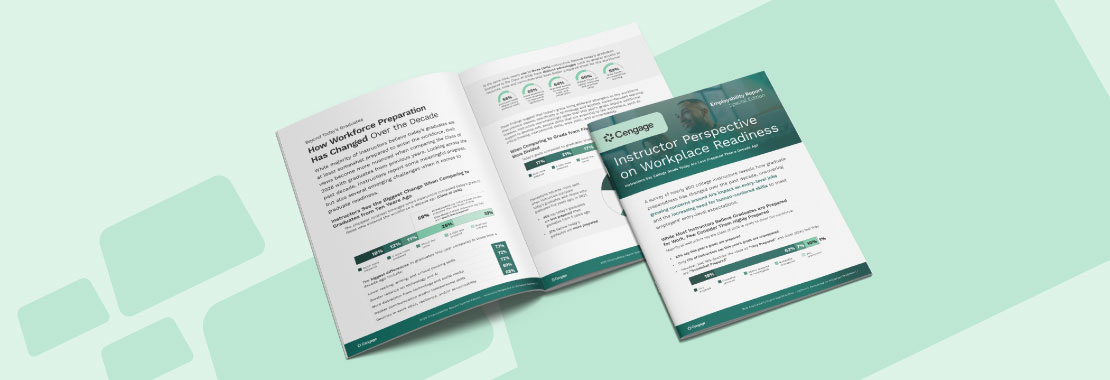
As AI becomes part of everyday work, institutions are rethinking how they prepare students to use the technology effectively and responsibly. New findings from Cengage’s Employability Report Special Edition: Instructor Perspective on Workplace Readiness show that many educators are already reconsidering what workforce readiness looks like in an AI-enabled world.
While 83% of instructors say the Class of 2026 is prepared for work, 58% also believe today’s graduates are less prepared than those who entered the workforce a decade ago.
Together, those findings point to a changing definition of workforce readiness.
Instructors aren’t questioning whether students can find jobs. They’re raising important questions about the skills students will need to succeed in a workforce shaped by AI and growing concerns about the AI impact on entry-level jobs.
Workforce readiness skills instructors want students to build
While instructors say students have greater access to technology than ever before, many worry that this type of access is creating a decline in some of the soft skills most valued in the workplace. Nearly 3 in 4 report declines in reading, writing, and critical-thinking skills among this year’s graduating class, while 69% point to weaker communication and interpersonal skills. At the same time, 72% say students have become more reliant on technology and AI.
That doesn’t mean educators are pushing back against technology. In fact, when asked how institutions can better prepare students for the future, instructors overwhelmingly focused on strengthening critical thinking, communication, and problem-solving skills while also helping students learn to use AI responsibly and effectively.
This highlights a growing workforce skills gap between the capabilities employers need and the skills students must develop before entering the workforce.
That also means instructors must create learning environments where content mastery, skill development, and AI-supported learning work together. We’re already seeing this happen within our Cengage’s Learning Platform, MindTap, where instructors bring together trusted course content, assessments, AI-powered support, and career readiness experiences in one place. From discipline-specific learning to soft-skills development, the goal is to help students make stronger connections between what they’re learning in the classroom and the skills they’ll need after graduation.
That doesn’t mean educators are pushing back against technology. In fact, when asked how institutions can better prepare students for the future, instructors overwhelmingly focused on strengthening critical thinking, communication and problem-solving skills while also helping students learn to use AI responsibly and effectively.
AI fluency and workforce readiness in the age of AI
As AI becomes a regular part of workflows, students will need more than familiarity with the technology itself. They’ll need the ability to evaluate information, apply judgment, and understand when AI should (and shouldn’t) be part of the process.
That’s one reason we’re seeing growing interest in AI-powered learning experiences that are embedded directly into learning rather than existing outside of it. Across higher education, the focus is increasingly on how AI can strengthen learning rather than simply accelerate tasks.
When AI is grounded in trusted course content, it becomes a tool for exploration rather than a shortcut.
Student Assistant was built with that in mind and trained only on Cengage content. It provides AI-powered support that helps students engage with concepts while learning to use AI responsibly. Rather than simply providing answers, it’s designed to guide students through the learning process and build the confidence they’ll need in an AI-enabled workplace.
When AI is grounded in trusted course content, it becomes a tool for exploration rather than a shortcut.
Why human skills matter for career readiness
The instructor findings also serve as a reminder that career readiness extends beyond technical knowledge. Communication, professionalism, resilience and interpersonal skills consistently emerged as areas where educators believe students need additional support.
These findings align with what employers value most: communication, collaboration, and the ability to apply knowledge in real-world situations. As a result, many institutions are looking for ways to make soft-skill development a more intentional part of the learning experience.
Within MindTap, we’re offering those exact experiences with new AI-powered activities (launching Fall 2026) to help students build confidence in areas like communication and workplace professionalism. These activities allow students to demonstrate how they think, communicate and apply what they’ve learned through presentations and workplace scenarios that strengthen the workforce readiness skills employers value most.
Closing the workforce skills gap through learning innovation
Preparing students for an AI-enabled workforce also means supporting the educators who are guiding them. Faculty are being asked to connect course concepts to real-world applications while helping students navigate emerging technologies. And AI can play a valuable role in that process; not as a replacement for instruction, but to strengthen it.
Instructor Assistant reflects that evolution. By surfacing actionable insights and helping educators identify where students may be struggling, Instructor Assistant makes it easier to understand learning patterns and intervene earlier, supporting both guided instruction and student success.
At the same time, institutions are increasingly looking for practical ways to bring AI concepts into existing coursework. Resources like Cengage’s upcoming “Using AI in Business Education Primer,” which will be available this fall for economics and business courses, can help faculty introduce foundational AI concepts, real-world business applications, and responsible AI use directly within existing coursework, making it easier to build AI literacy without redesigning an entire course.
Workforce readiness won’t be defined by AI skills alone. It will be shaped by students’ ability to combine technical fluency with critical thinking, communication and adaptability.
As the instructor findings suggest, higher education’s challenge isn’t preparing students for a future with AI; that future is already here. The opportunity is helping students build the skills — and confidence — to succeed alongside it.
Educators can explore resources designed to help students build AI literacy, communication skills, and workforce readiness, including the upcoming AI in Business Education Primer and new MindTap AI-powered activities.
Frequently Asked Questions (FAQ) About Workforce Readiness
What is workforce readiness?
Workforce readiness refers to the knowledge, skills, and behaviors students need to successfully transition from education into the workplace. Today, workforce readiness includes both technical competencies and human-centered skills such as communication, critical thinking, professionalism and adaptability.
Why are college graduates less prepared for the workforce today?
According to Cengage’s “Employability Report Special Edition: Instructor Perspective on Workplace Readiness,” 58% of instructors believe today’s graduates are less prepared for work than graduates from a decade ago. Educators cited declines in critical thinking, communication skills, and growing dependence on technology and AI.
How can colleges improve workforce readiness?
Instructors say colleges can improve workforce readiness by strengthening critical thinking, communication and problem-solving skills, expanding experiential learning opportunities and helping students learn to use AI responsibly and effectively.
What skills are employers looking for in college graduates?
While technical knowledge remains important, employers continue to value communication, teamwork, professionalism, adaptability and critical-thinking skills. As AI becomes more common in the workplace, human-centered skills are becoming increasingly important.
Where can I learn more about career readiness and AI in higher education?
For a broader look at workforce readiness, explore the Cengage Graduate Employability Report. The report examines how recent graduates are preparing for careers in an AI-enabled workforce, including their perspectives on AI fluency, career readiness, employer expectations and the skills they believe are most important for long-term success.
